0:00
The gap: inference bills show tokens and dollars.
Sustainability teams may also need carbon and water estimates for inference workloads. CarbonLayer puts those modeled estimates beside the request receipt.
Screen 1 · the homepage
Prototype walkthrough · real API receipts
The sample HTTP call reaches the real API and the displayed receipt is a real captured response. Model output and dispatch are simulated. Environmental values are modeled estimates; region targets and latency are seeded snapshots, not physical devices. The physical edge network is in development.
No demo call is needed. Use the written walkthrough, then send a workload if you want to discuss a pilot.
CO₂e · modeled estimate
5.94 g
Water · modeled estimate
76.05 mL
Saved · modeled baseline
136.6 g
Latency · seeded
78 ms
Beat by beat · 3:00 total
Each displayed API value is from a captured real receipt. The model output and dispatch are simulated, environmental values are modeled estimates, and target latency is seeded.
0:00
Sustainability teams may also need carbon and water estimates for inference workloads. CarbonLayer puts those modeled estimates beside the request receipt.
Screen 1 · the homepage
0:25
Send a model label, prompt, token budget, and latency preference to the prototype API. Model output and dispatch are simulated; the region target and latency are seeded snapshots.
Screen 2 · the docs quickstart
0:55
The sample POST reached the real API and returned a persisted receipt. Its model output and dispatch are simulated, and its carbon, water, and energy values are modeled estimates.
Screen 3 · the response contract and captured receipt
1:35
GET /api/savings is authenticated and scoped to the API key. The captured example returned HTTP 200 with three dispatches; it is not a public anonymous ledger.
Screen 4 · the captured key-scoped savings response
2:05
GET /api/network is public and returns the current seeded target snapshot. Environmental values are modeled, latency is seeded, and these targets are not physical devices.
Screen 5 · the public seeded network snapshot
2:35
The Free tier is listed at $0 per month with 50,000 calls per month. Start with an account, or send a workload through the existing contact form for a pilot discussion.
Screen 6 · the pricing snapshot
Prototype boundary
No language-model provider is called for this demo. The API receipt is real, while generated model output and dispatch are simulated. Read the methodology and provenance notes for the calculation boundaries.
Annotated screens
These are local captures of the existing CarbonLayer home, docs, and pricing routes. No screenshot from the unavailable reference asset paths is used.
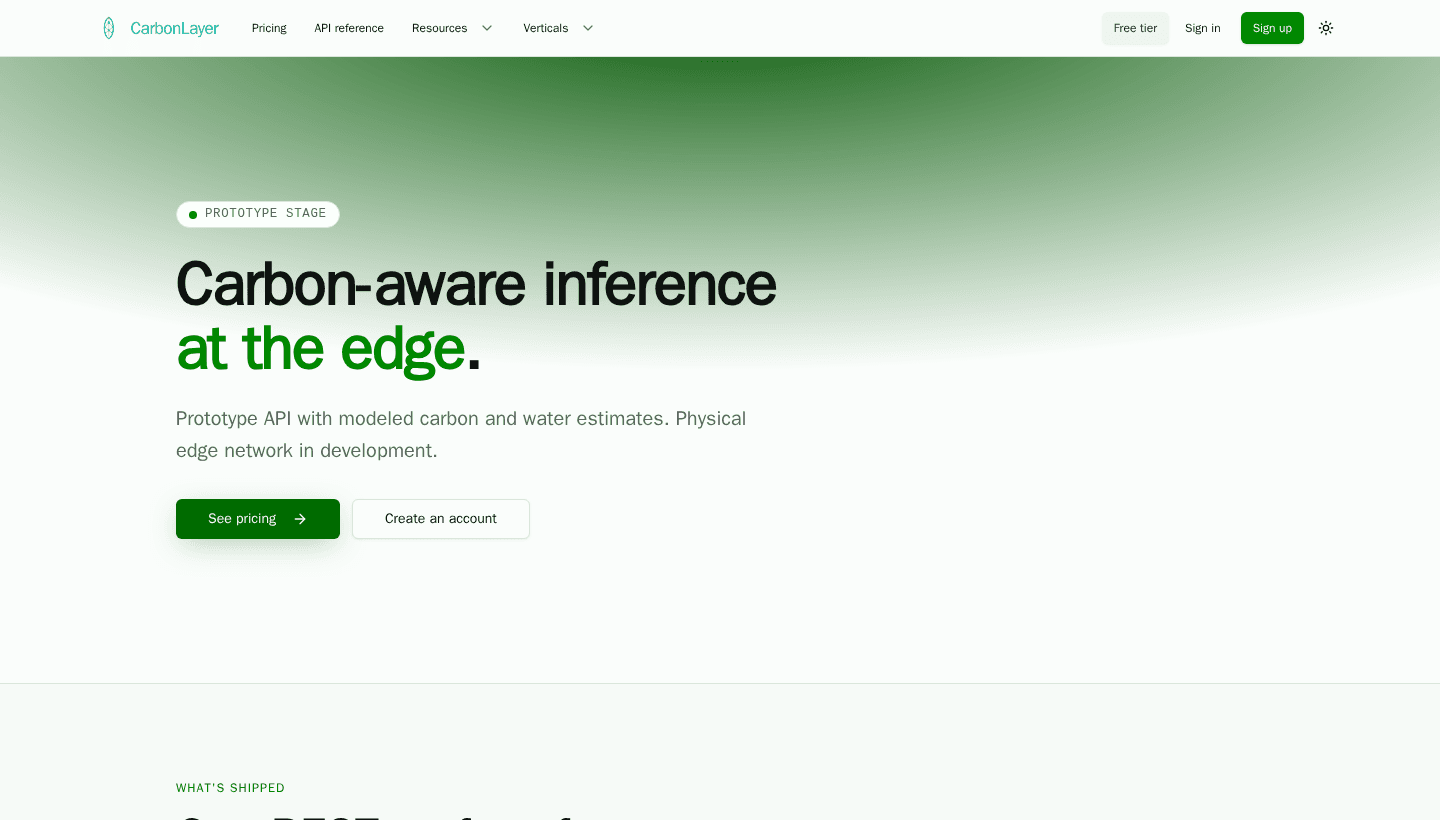
Screen 1 · home
The current home page states that carbon and water figures are modeled and that the physical edge network is in development.
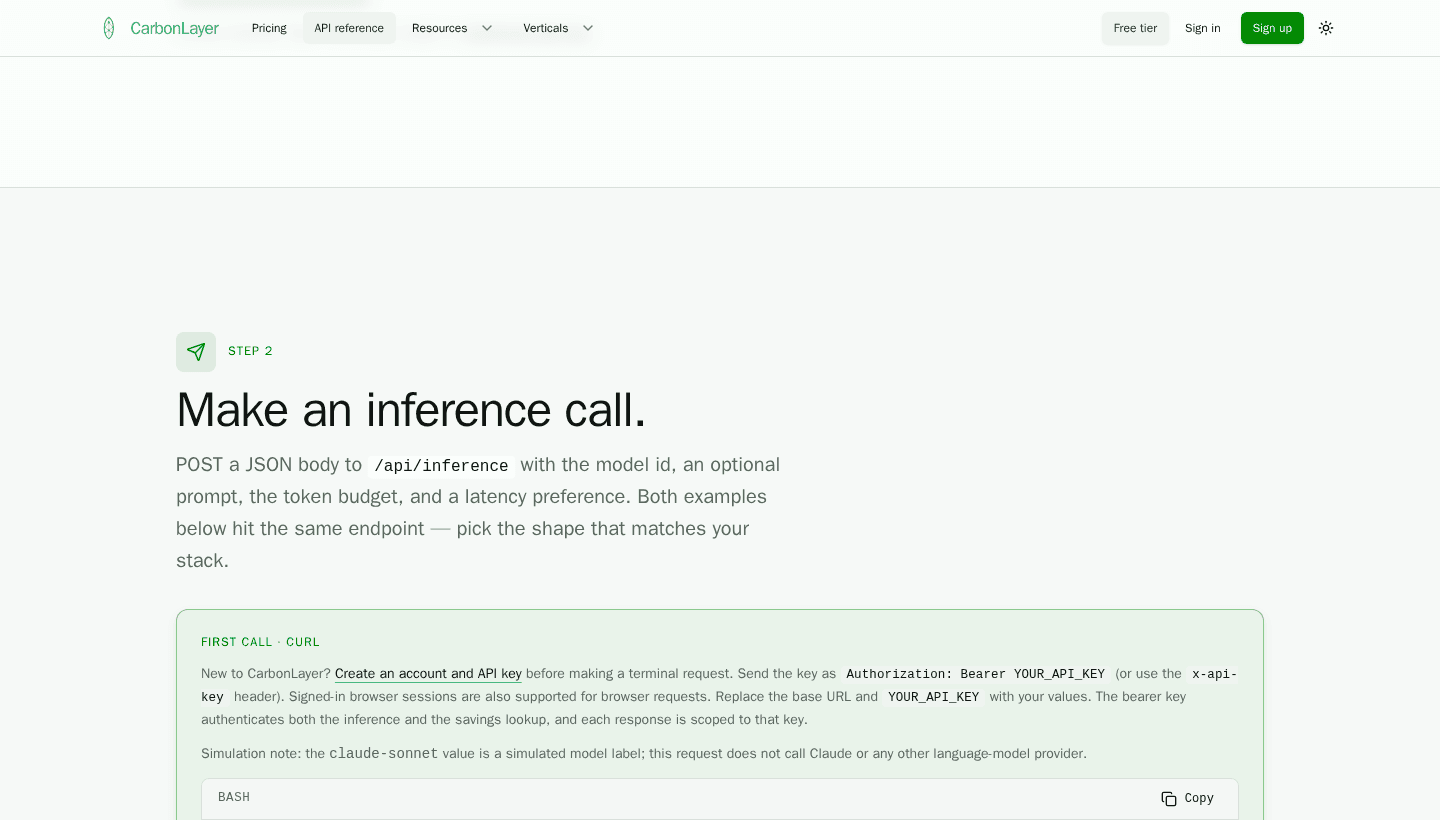
Screen 2 · API reference
The docs show the request body and identify claude-sonnet as a simulated model label. The prototype does not call a language-model provider.
Read the methodology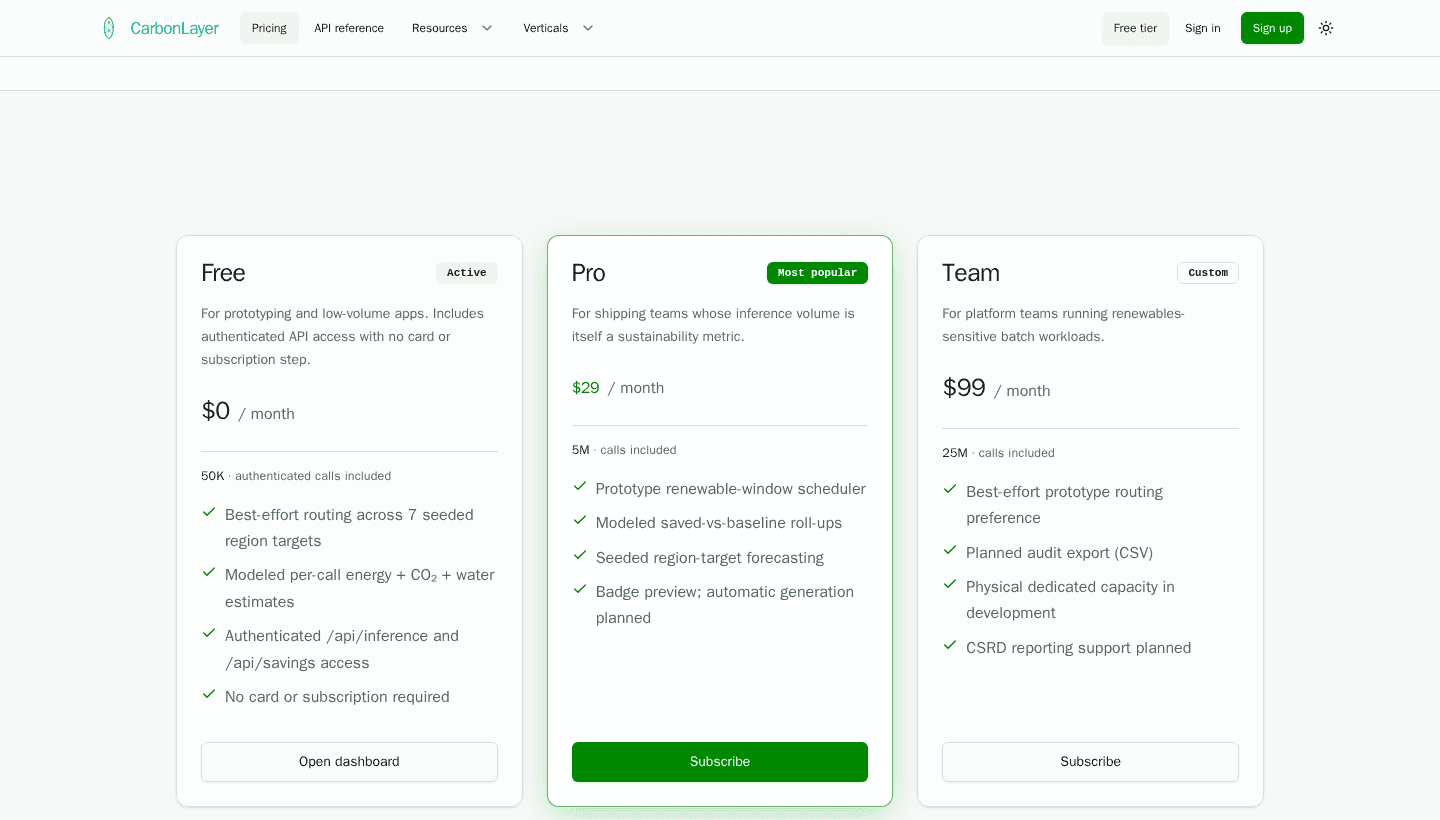
Screen 3 · pricing
Pro and Team are optional, availability-qualified tiers. Hosted checkout depends on Stripe Connect configuration.
See current pricingReal API calls · captured 23 Sep 2026
The sample HTTP calls and recorded receipts are real. Model output and dispatch are simulated. Carbon, water, energy, and baseline comparisons are modeled estimates; each latency is a seeded target value.
curl -sS -X POST https://carbonlayer.polsia.io/api/inference \
  -H "Authorization: Bearer YOUR_API_KEY" \
  -H "Content-Type: application/json" \
-d '{"prompt":"Draft a status update for a 12% emissions drop in Marseille.","model":"claude-sonnet","tokens":880,"preferLowLatency":false}'{
"model": "claude-sonnet",
"tokens": 880,
"energyKwh": 0.216,
"carbonGrams": 5.94,
"waterMl": 76.05,
"latencyMs": 78,
"baselineCarbonGrams": 129.6,
"savedCarbonGrams": 136.6,
"device": {
"name": "Oslo Harbour Hydro Cluster",
"region": "eu-north-1",
"carbonIntensity": 25,
"renewableMix": 0.82,
"carbonIntensitySource": "modeled"
},
"carbonSource": "modeled",
"waterSource": "modeled",
"energySource": "modeled",
"source": "synthetic"
}carbonSource, waterSource, energySource, and the device intensity source are modeled. The response source is synthetic; the target and its latency are seeded.
5.94 g CO₂e
Modeled estimate
76.05 mL water
Modeled estimate
136.6 g saved
Modeled baseline comparison
78 ms
Seeded target latency
| Example · model | Tokens | CO₂e · modeled | Water · modeled | Saved vs baseline · modeled | Latency · seeded |
|---|---|---|---|---|---|
| Marseille status updateclaude-sonnet | 880 | 5.94 g | 76.05 mL | 136.6 g · 351.7 mL | 78 ms |
| EU grid-intensity summaryclaude-haiku | 120 | 0.54 g | 6.9 mL | 12.4 g · 32.0 mL | 78 ms |
| Support-ticket classifiercl-compact-v1 | 60 | 0.30 g | 3.9 mL | 6.9 g · 17.8 mL | 78 ms |
Tokens
880
CO₂e · modeled
5.94 g
Water · modeled
76.05 mL
Saved · modeled
136.6 g · 351.7 mL
Latency · seeded
78 ms
Tokens
120
CO₂e · modeled
0.54 g
Water · modeled
6.9 mL
Saved · modeled
12.4 g · 32.0 mL
Latency · seeded
78 ms
Tokens
60
CO₂e · modeled
0.30 g
Water · modeled
3.9 mL
Saved · modeled
6.9 g · 17.8 mL
Latency · seeded
78 ms
The captured key-scoped GET /api/savings response returned HTTP 200 and three dispatches. Its authenticated ledger is scoped to the key that made those requests. For the calculation boundaries behind each modeled value, read the methodology.
GET /api/network · public seeded snapshot
This is the captured snapshot shown by the public API. Grid intensity and renewable mix are modeled estimates. Latency values are seeded for region targets; the physical edge network is in development, so these are not physical devices.
Open the current /api/network JSON snapshot
| Region target | Country | Grid intensity · modeled | Renewable mix · modeled | Latency · seeded |
|---|---|---|---|---|
| Oslo Harbour Hydro Clustereu-north-1 | Norway | 25 g/kWh | 81.6% | 78 ms |
| Quebec Hydro Edgeus-east-1 | Canada | 37.5 g/kWh | 71.1% | 92 ms |
| São Paulo Hydro Roofsa-east-1 | Brazil | 36.0 g/kWh | 79.1% | 184 ms |
| Tasmania Wind + Hydrooc-east-1 | Australia | 51.8 g/kWh | 74.1% | 220 ms |
| Columbia Gorge Wind Podus-west-2 | United States | 94.1 g/kWh | 56.1% | 110 ms |
| Andalucía Solar Labeu-west-2 | Spain | 180.2 g/kWh | 21.3% | 150 ms |
| Karnataka Renewable Bridgeap-south-1 | India | 261.8 g/kWh | 42.5% | 168 ms |
Grid intensity · modeled
25 g/kWh
Renewable mix · modeled
81.6%
Latency · seeded
78 ms
Grid intensity · modeled
37.5 g/kWh
Renewable mix · modeled
71.1%
Latency · seeded
92 ms
Grid intensity · modeled
36.0 g/kWh
Renewable mix · modeled
79.1%
Latency · seeded
184 ms
Grid intensity · modeled
51.8 g/kWh
Renewable mix · modeled
74.1%
Latency · seeded
220 ms
Grid intensity · modeled
94.1 g/kWh
Renewable mix · modeled
56.1%
Latency · seeded
110 ms
Grid intensity · modeled
180.2 g/kWh
Renewable mix · modeled
21.3%
Latency · seeded
150 ms
Grid intensity · modeled
261.8 g/kWh
Renewable mix · modeled
42.5%
Latency · seeded
168 ms
The public endpoint returns its current seeded snapshot, which may change as the snapshot is refreshed. Values in this walkthrough are the captured example.
Pricing snapshot · captured 23 Sep 2026
The snapshot below preserves the displayed Free, Pro, and Team prices. See the current pricing route for availability and billing details; hosted checkout depends on Stripe Connect configuration.
50,000 calls / month
Prototype estimates are modeled; the physical edge network is in development.
5M calls / month
Prototype estimates are modeled; the physical edge network is in development.
25M calls / month
Prototype estimates are modeled; the physical edge network is in development.
Team CSV export is on the roadmap, not an available feature. Review the current pricing page.
Workload → pilot
Share a few details through the existing contact form. CarbonLayer can use them to discuss a pilot against the seeded prototype fleet; the estimates remain modeled.
Send a workload